As cities expand and land becomes increasingly valuable, high-rise buildings offer a practical way to accommodate more people, businesses, and services within limited urban space. However, building taller is not enough; modern towers must also operate efficiently, use resources responsibly, and deliver lasting financial value. Sustainable high-rise building design brings together energy efficiency, environmentally responsible materials, intelligent building systems, occupant comfort, and lifecycle cost management to create buildings that perform well long after construction is complete.
For developers, investors, and property owners, sustainability is increasingly connected to operating costs, building performance, resilience, marketability, and long-term return on investment. From high-performance façades and energy-efficient HVAC systems to low-carbon materials, renewable energy, water conservation, and passive design strategies, the decisions made during the early design stages can significantly influence a tower’s environmental and financial performance.
The Building Practice Ltd applies architectural and engineering expertise to help clients approach complex building projects with a focus on performance, functionality, safety, and long-term value. This guide examines the key principles of sustainable high-rise building design, including energy efficiency, sustainable materials, smart technologies, and lifecycle considerations, while explaining how these strategies can help create high-performance towers that are both environmentally responsible and commercially valuable.
Contact The Building Practice Ltd
Phone: +234 904 9721 840
Email: info@buildingpractice.biz
Address: Plot 6, Remi Olowude Street, Lekki Phase 1, Lagos
Website: The Building Practice Ltd
Stay connected with The Building Practice
Follow @thebuildingpractice on Instagram for professional insight for expert insights on top architectural design and innovation.
What Makes a High-Rise Building Sustainable
A sustainable high-rise is designed to perform efficiently across its entire lifecycle from material extraction to demolition.
Environmental Performance Benchmarks
Sustainable towers are measured using:
- Energy Use Intensity (EUI)
- Carbon footprint per m²
- Water consumption per occupant
- Indoor air quality metrics
Life-Cycle Thinking in Tall Building Design
Design decisions consider:
- Embodied carbon in concrete, steel, and glass
- Operational energy over 50+ years
- Maintenance requirements
- End-of-life recyclability
Planning a high-performance tower? Our team specializes in sustainable high-rise design strategies that balance environmental performance with structural efficiency.
Energy Efficiency Strategies in High-Rise Buildings
Energy use in tall buildings can be 30–50% higher than low-rise structures without optimized design.
High-Performance Building Envelopes
Façades act as environmental filters. Key technologies:
- Low-e glazing
- Thermal breaks
- Insulated spandrel panels
Passive Design and Solar Shading Techniques
Shading devices, building orientation, and façade articulation reduce solar heat gain.
Daylighting Optimization in Tall Structures
Light shelves and atrium designs distribute daylight deeper into floor plates.
Thermal Insulation and Heat Gain Control
Proper envelope detailing reduces HVAC load and condensation risk.
Advanced HVAC and Mechanical Efficiency Systems
HVAC systems are the largest energy consumers in skyscrapers.
Chilled Water Plants and Energy Recovery
Heat recovery chillers and variable-speed drives improve energy efficiency.
Demand-Controlled Ventilation
Sensors adjust airflow based on CO₂ levels and occupancy.
Smart Zoning for Vertical Climate Control
Mechanical floors divide buildings into pressure zones to optimize cooling and heating.
We design energy-efficient MEP systems for high-rise buildings, ensuring lower operating costs and long-term sustainability performance.
Renewable Energy Integration in Tall Buildings
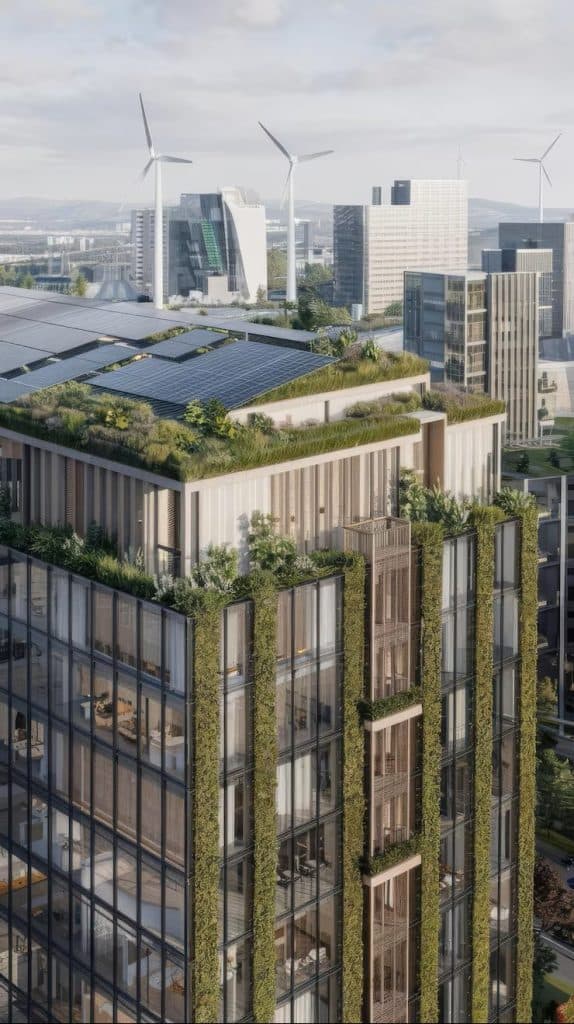
Solar PV Systems for High-Rise Roofs and Facades
Building-integrated photovoltaics (BIPV) turn façades into energy generators.
Wind Turbine Applications in Skyscrapers
Some towers integrate wind channels to harness airflow.
Energy Storage and Hybrid Power Solutions
Battery systems store renewable energy for peak demand.
Sustainable Material Selection for High-Rise Construction
Material choice impacts embodied carbon and durability.
Low-Carbon Concrete and Recycled Steel
Supplementary cementitious materials reduce emissions.
Locally Sourced and Renewable Materials
Minimizes transportation energy.
High-Durability Façade Materials
Extends lifecycle and reduces replacement costs.
Embodied Carbon Reduction Strategies
Structural optimization reduces material quantity.
Water Efficiency and Resource Management
Rainwater Harvesting Systems
Supports irrigation and flushing systems.
Greywater Recycling in Tall Buildings
Reuses water from sinks and showers.
Efficient Plumbing Fixtures and Systems
Low-flow fixtures cut consumption.
Smart Building Technologies for Sustainability
Building Automation Systems (BAS)
Controls lighting, HVAC, and energy performance.
Real-Time Energy Monitoring
Enables data-driven optimization.
Predictive Maintenance Technologies
Reduces system downtime and waste.
We integrate smart building technologies into sustainable high-rise projects to improve performance, monitoring, and lifecycle efficiency.
Indoor Environmental Quality in High-Rise Design
Healthy indoor spaces improve productivity and satisfaction.
Air Quality Control and Filtration
HEPA filtration and fresh air supply.
Acoustic Comfort in Vertical Living
Sound insulation between floors.
Natural Light and Occupant Well-Being
Daylight improves mental health.
Façade Engineering for Energy Performance
Façade systems directly influence cooling loads.
Double-Skin Façades
Enhance insulation and ventilation control.
High-Performance Glazing Systems
Reduces solar radiation penetration.
Dynamic Shading Technologies
Automated shading improves efficiency.
RECOMMENDED:
The Complete High-Rise Building Design Process: From Concept to Construction
Structural Systems Used in High-Rise Buildings and How They Affect Cost & Safety
Cost of Constructing a High-Rise Building in Nigeria: Budget, Materials, and Risks
Sustainable Structural Systems for Tall Buildings
Optimized Structural Grids
Reduces material waste.
Lightweight Structural Materials
Lower dead loads.
Modular and Prefabricated Systems
Minimizes construction waste and time.
Green Building Certifications for High-Rise Projects
Certifications validate performance:
- LEED
- BREEAM
- EDGE
Long-Term Value of Sustainable High-Rise Buildings
Reduced Operational Costs
Lower energy bills.
Increased Asset Value and Marketability
Green properties command higher rents.
Resilience Against Climate Risks
Better durability and adaptability.
Cost Implications of Sustainable High-Rise Design
Initial capital may rise 3–10%, but lifecycle savings offset costs.
Challenges in Sustainable High-Rise Development
- Technical complexity
- Skilled labor shortages
- Higher design coordination
Future Trends in Sustainable Skyscraper Design
- Net-zero towers
- Carbon-neutral materials
- AI-driven building optimization
Start Your Sustainable High-Rise Project Today
Designing a sustainable high-rise requires deep expertise in energy modeling, façade engineering, structural optimization, and green building standards. We specialize in sustainable high-rise building design, helping developers create energy-efficient, environmentally responsible, and financially resilient towers.
Contact our sustainable high-rise design team today to turn your project into a high-performance landmark that delivers long-term value.
Phone: +234 904 9721 840
Email: info@buildingpractice.biz
Address: Plot 6, Remi Olowude Street, Lekki Phase 1, Lagos
Website: The Building Practice Ltd
Stay connected with The Building Practice
Follow @thebuildingpractice on Instagram for professional insight for expert insights on top architectural design and innovation.
Frequently Asked Question About Sustainable High-Rise Building Design
What is sustainable high-rise building design?
Sustainable high-rise building design focuses on reducing energy consumption, lowering carbon emissions, improving indoor environmental quality, and maximizing lifecycle value through efficient systems, green materials, and smart technologies.
Which materials are best for sustainable tall buildings?
Low-carbon concrete, recycled steel, durable façade systems, locally sourced materials, and renewable materials help reduce embodied carbon and extend building lifespan.
Do sustainable high-rise buildings cost more to build?
Initial construction costs can increase slightly, but energy savings, lower maintenance expenses, and higher property value provide strong long-term financial returns.
How does façade design affect sustainability?
Façade systems control heat gain, daylight entry, and insulation performance. High-performance glazing, double-skin façades, and shading devices significantly lower cooling loads.
Can renewable energy be used in skyscrapers?
Yes. Solar photovoltaic panels, building-integrated PV systems, energy storage, and hybrid power solutions help offset grid energy use.
What role do smart building systems play in sustainability?
Building automation systems monitor and control HVAC, lighting, and energy use in real time, improving efficiency and reducing waste.
What certifications apply to sustainable high-rise buildings?
LEED, BREEAM, and EDGE certifications verify environmental performance and improve investor confidence.